Best boot dryers
The best boot dryers
Six dryers on drying power, capacity and noise - and the case that this is the best value purchase in hunting footwear.
Convection against forced air, what reaches up a knee boot, and the odor and leather routine that decides whether a $250 boot lasts two seasons or ten.
Belt & Bike earns a commission when you buy through our links, at no extra cost to you. Prices come from Amazon and change; the date beside every price is when we last verified it. Full disclosure.
Ranked on the specifications below. Prices are live and dated; where no live price resolves, the cell reads Check price.
| # | Product | Type | Score | Price |
|---|---|---|---|---|
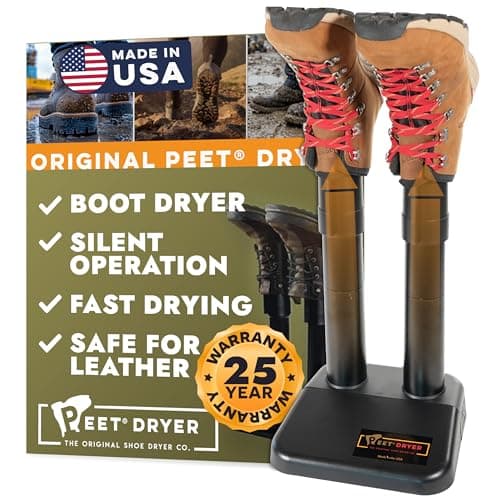
| Rank 1 | PEET Original 2-shoe dryer Silent overnight drying | Convection, fanless | 8.3 | $49.99Amazon |
| Rank 2 | 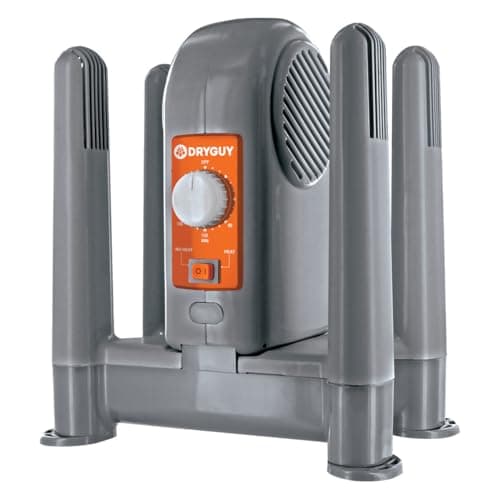 DryGuy Force Dry DX Two pairs of anything, fast | Forced air with heat | 8.2 | $78.75Amazon |
| Rank 3 | 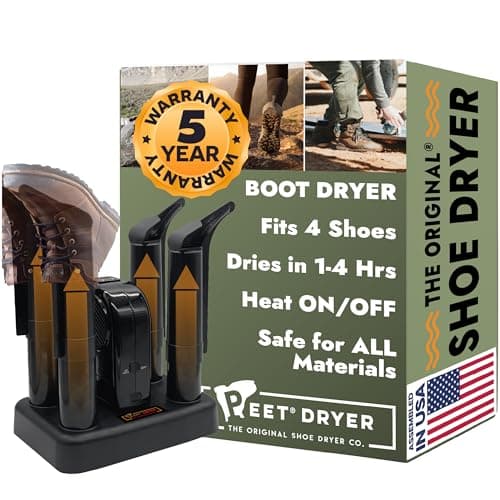 PEET Advantage Plus 2-pair Two pairs, faster | Forced air with heat | 8.0 | $119.99Amazon |
| Rank 4 | 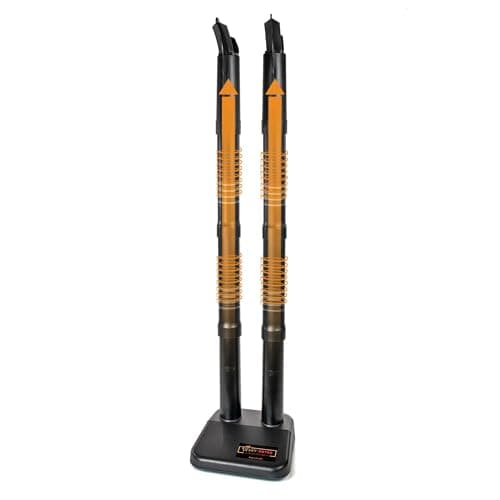 PEET Wader dryer with 12-inch extensions Waders and knee boots | Convection with extension tubes | 8.2 | $79.99Amazon |
| Rank 5 | 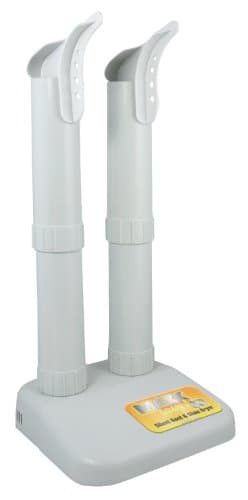 MaxxDry boot dryer Tall boots and waders on a budget | Forced air | 7.5 | $49.95Amazon |
#ad Prices come from Amazon and change. How this site is funded. Scores are our published editorial rubric — see our methodology.
A boot that is still damp in the morning starts you cold, and a boot stored damp grows the smell that never comes out. Both problems have the same cheap solution, and it is the piece of gear hunters buy last: a dryer that moves air through the inside of the boot, not a radiator that cooks the outside.
Do not put boots on a radiator, in front of a wood stove, or in a clothes dryer. Heat above roughly 120F shrinks and cracks leather, delaminates glue lines and can damage a waterproof membrane permanently. The whole point of a purpose-built dryer is that it works at a temperature that cannot do that.
| Convection (fanless) | Forced air (fan and heater) | |
|---|---|---|
| How it works | Warm air rises through the boot | A fan pushes warm air in |
| Typical dry time | 4 to 8 hours (manufacturer) | 1 to 3 hours (manufacturer) |
| Noise | Silent | Clearly audible |
| Power | Nightlight-level | Higher, but only for a few hours |
| Things that break | Essentially nothing | The fan, eventually |
| Buy it if | You take boots off at dark and hunt in the morning | You need two pairs turned around fast, or you dry gloves too |
For most hunters the silent convection dryer is correct: it runs all night in a mudroom for almost nothing, it will never cook a boot, and PEET's units genuinely last decades. Forced air earns its noise when you hunt back-to-back sessions or dry gloves and a hat as well. The full comparison and PEET against DryGuy work through the specifics.
Almost every dryer puts air into the foot of the boot and stops there. In an 18-inch rubber pull-on or a pair of waders, the part that stays wet is the shaft, and that is where the smell comes from. Extension tubes are the only real answer - PEET sells a 12-inch wader version and MaxxDry builds tall tubes in. If you hunt in knee boots, this is not an upgrade, it is the requirement: dryers for waders and knee boots.
The detail, including what to do with a boot that already smells, is in the boot odor guide.
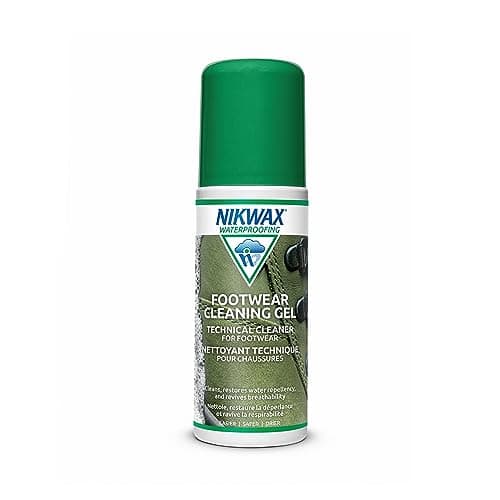
The most common mistake here is using the wrong product, confidently. Match the treatment to what the boot is actually made of:
8 pages in this section. Roundup tiles carry the live price and a buy link for their top pick.
Best boot dryers
Six dryers on drying power, capacity and noise - and the case that this is the best value purchase in hunting footwear.
Best for waders
The shaft is the part that never dries, and most dryers stop at the ankle. Extension tubes are the answer.
Best deodorizers
Odor is a moisture problem in disguise - and for deer hunters, fragrance is not an available solution.
Comparison
Silent and slow with nothing to break, against fast and loud with more capacity. Two different physics.
Comparison
One uses a fan, one uses rising air - and that single difference drives speed, noise, power and reliability.
Guide
The method, the safe fast version, and the five heat sources that ruin boots. Water does not kill footwear - heat does.
Guide
Odor is bacteria metabolizing sweat, so it is a moisture problem. Remove the water, and skip the fragrance entirely.
Guide
Most boots die in storage, not in the field. UV, fuel fumes and damp do more damage than a season of hunting.